Maps of North Africa Without Sudan Funny
| Bir Tawil بير طويل | |
|---|---|
| Unclaimed land | |
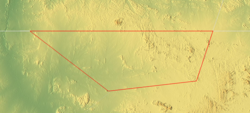 Topographic map of Bir Tawil (highlighted in ruby) | |
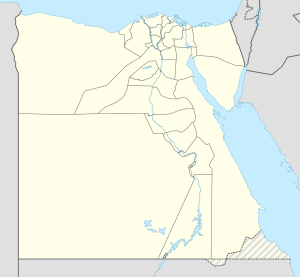
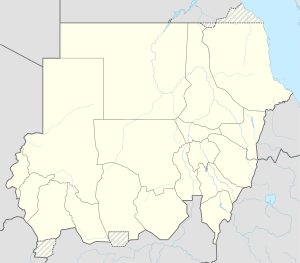
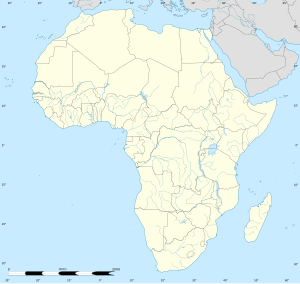
| Bir Tawil Location betwixt Egypt and Sudan Show map of Arab republic of egypt Bir Tawil Bir Tawil (Sudan) Show map of Sudan Bir Tawil Bir Tawil (Africa) Show map of Africa | |
| Coordinates: 21°52′nine″N 33°44′52″East / 21.86917°North 33.74778°Eastward / 21.86917; 33.74778 Coordinates: 21°52′9″Northward 33°44′52″Due east / 21.86917°Northward 33.74778°E / 21.86917; 33.74778 | |
| Country | None |
| Area | |
| • Total | 2,060 km2 (800 sq mi) |
| Population (2018) | |
| • Full | 0 |
| Transient populations only[1] | |

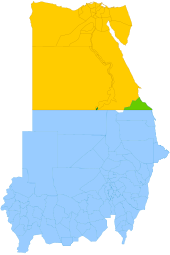
Simplified map showing Egypt's merits (yellowish and light-green), Sudan's merits (bluish and green), the Hala'ib Triangle (light light-green), Wadi Halfa Salient (dark light-green) and Bir Tawil (the white area betwixt Egypt and Sudan)
Bir Tawil (; Egyptian Arabic: بير طويل, romanized: Bīr Ṭawīl , lit.'alpine h2o well', [biːɾ tˤɑˈwiːl]) is a ii,060 kmtwo (795.4 sq mi) expanse of land along the border between Egypt and Sudan, which is uninhabited and claimed by neither country. When spoken of in association with the neighbouring Halaib Triangle, information technology is sometimes referred to as the Bir Tawil Triangle, despite the area's quadrilateral shape; the two "triangles" edge at a quadripoint.
Its terra nullius status results from a discrepancy between the directly political boundary between Egypt and Sudan established in 1899, and the irregular authoritative boundary established in 1902. Egypt asserts the political boundary, and Sudan asserts the administrative boundary, with the result that the Hala'ib Triangle is claimed by both and Bir Tawil by neither. In 2014, author Alastair Bonnett described Bir Tawil as the but identify on Globe that was habitable merely was not claimed by any recognised regime.[ii]
History
On 19 Jan 1899, an agreement between the United Kingdom and Egypt relating to the administration of Sudan divers "Soudan" as the "territories south of the 22nd parallel of latitude".[3] It contained a provision that would give Egypt control of the Red Sea port of Suakin , simply an amendment on x July 1899 gave Suakin to Sudan instead.[3]
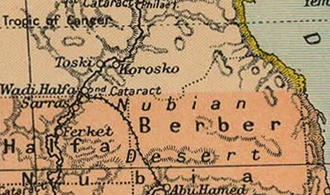
Map of the Hala'ib Triangle and Bir Tawil from 1912
On iv November 1902, the UK drew a separate "authoritative purlieus", intended to reflect the bodily employ of the state by the tribes in the region.[iii] Bir Tawil was grazing state used past the Ababda tribe based near Aswan , and thus was placed under Egyptian administration from Cairo. Similarly, the Hala'ib Triangle to the northeast was placed nether the British governor of Sudan, considering its inhabitants were culturally closer to Khartoum.
Egypt claims the original border from 1899, the 22nd parallel, which would place the Hala'ib Triangle within Arab republic of egypt and the Bir Tawil area inside Sudan. Sudan, notwithstanding, claims the administrative border of 1902, which would put Hala'ib within Sudan, and Bir Tawil within Egypt. As a result, both states claim Hala'ib and neither claims the much less valuable Bir Tawil expanse, which is simply a tenth the size, and has no permanent settlements or access to the sea. In that location is no basis in international law for either Sudan or Arab republic of egypt to merits both territories, and neither nation is willing to cede Hala'ib . With no third state claiming the neglected area, Bir Tawil is one of the few state areas of the world not claimed by any recognised state.[4] [5]
Geography
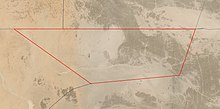
2021 satellite image of Bir Tawil (highlighted in red) by Landsat 8.
Bir Tawil is two,060 km2 (795 sq mi) in size. The length of its northern and southern borders are 95 kilometres (59 mi) and 46 kilometres (29 mi) respectively; the length of its eastern and western borders are 26 kilometres (16 mi) and 49 kilometres (xxx mi) respectively. In the north of the surface area is the mountain Jabal Tawil ( جبل طويل ), with a height of 459 metres (1,506 ft). In the eastward is Jebel Hagar ez Zarqa , with a height of 662 metres (two,172 ft). In the south is the Wadi Tawil ( وادي طويل ), also called Khawr Abū Bard .
Climate
Bir Tawil 'southward climate is, according to the Köppen climate classification, a very hot desert climate (Bwh). During the summertime months, approximately three-quarters of the year, temperatures tin can exceed xl °C (104 °F), while its hottest three months (June–August) tin see it as high as 45 °C (113 °F). During the brief winters, however (December and January being its mildest months), Bir Tawil can experience milder temperatures with 26 °C (79 °F) as its usual temperature superlative.
Because the territory is far from the ocean (being at least 200 km (120 mi) away from the Red Sea), the diurnal temperature range throughout the region is big, varying from eighteen to 20 °C (32 to 36 °F), twelvemonth-round.[6]
| Climate data for Bir Tawil | |||||||||||||
|---|---|---|---|---|---|---|---|---|---|---|---|---|---|
| Month | Jan | Feb | Mar | Apr | May | Jun | Jul | Aug | Sep | Oct | Nov | December | Year |
| Average high °C (°F) | 26 (79) | 28 (82) | 32 (xc) | 37 (99) | forty (104) | 42 (108) | 42 (108) | 42 (108) | 41 (106) | 38 (100) | 32 (90) | 27 (81) | 36 (96) |
| Average low °C (°F) | vii (45) | 8 (46) | 11 (52) | 16 (61) | twenty (68) | 22 (72) | 24 (75) | 24 (75) | 22 (72) | 19 (66) | 13 (55) | 9 (48) | 16 (61) |
| Source: MeteoBlue.com [seven] | |||||||||||||
Claims
Due to its status equally de jure unclaimed territory, a number of individuals and organizations have attempted to claim Bir Tawil as a micronation. All the same, none have been taken seriously by the international community, and due to the remoteness and hostile climate of the region, the vast majority of these claims have been by declarations posted online from other locations. None of these claims, or any others, take been recognized, officially or otherwise, by whatsoever government or international organization.[8] [9] [x]
Population
Bir Tawil has no settled population, only members of the Ababda and Bishari tribes pass through the region.[eight]
Encounter also
- Egypt–Sudan border
- Egypt–Sudan relations
- Halaib Triangle, an adjoining area, claimed past both Egypt and Sudan
- Terra nullius
- Wadi Halfa Salient
References
- ^ Karalekas, Dean (2020). "Navigating Terra Nullius: The Ababda and the Case for Indigenous Country Rights in Bir Tawil" (PDF). Global Journal of Economics and Finance. 4 (2): 41–49.
- ^ Bonnett, Alastair (2014). "Bir Tawil". Unruly Places: Lost Spaces, Underground Cities and Other Inscrutable Geographies. Houghton Mifflin Harcourt. p. 73. ISBN978-0-544-10160-9. LCCN 2013050983. OCLC 890509603.
the only place on the planet that is both habitable and unclaimed.
- ^ a b c "International Boundary Report: Sudan – Egypt (United Arab Republic) Purlieus" (PDF). law.fsu.edu. Bureau of Intelligence and Research. 27 July 1962. pp. two, 3. Archived from the original (PDF) on thirteen January 2014. Retrieved 2019-05-28 .
- ^ "Official version of map of Egypt". Archived from the original on 2013-05-26. Retrieved 2017-03-05 .
- ^ "Egypt". CIA World Factbook 2010. CIA. 2010. ISBN9781602397279.
- ^ "Climate: Bir Tawil
- ^ "Weather for Bir Tawil". MeteoBlue.com. Retrieved 6 November 2019.
- ^ a b Shenker, Jack (three March 2016). "Welcome to the country that no country wants". The Guardian . Retrieved three March 2016.
- ^ Liston, Enjoli (16 July 2014). "American plans to use his piece of Africa for advancement of scientific discipline". The Guardian. London. Retrieved xvi Oct 2017.
- ^ "I claim this piece of Africa for my daughter, Princess Emily". the Guardian. 2014-07-15. Retrieved 2021-08-05 .
External links
 | Wikimedia Commons has media related to Bir Tawil. |
- Google Sightseeing - Bir Tawil Triangle
- International Boundary Study
Source: https://en.wikipedia.org/wiki/Bir_Tawil

Post a Comment for "Maps of North Africa Without Sudan Funny"