I Have a Terms of Use Violation (2) on Youtube but Never Uploaded a Video
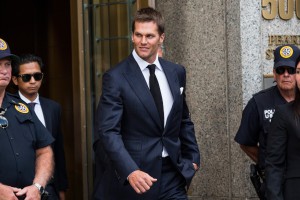
Here's one more thing you tin can arraign Tom Brady for. (Photo past Andrew Burton/Getty Images)
Providing a link to content is a pretty standard manner of pointing your friends, family, or colleagues to an interesting article you read, a funny picture you saw, or information you want to share. I know that I provide links on a daily ground, including them in blog posts, emails, manufactures, and briefs, or on Facebook and Twitter. While I assume that the fabric I share does not infringe copyright, to be honest, I typically don't requite it much thought when I share an interesting weblog postal service or a stunning movie by providing the link to the page I originally institute the content. Hyperlinking is simply a typical manner the average person interacts with the internet today.
Merely what if it wasn't immune? Or what if every time you provided a link, y'all had to worry that you might exist sued for copyright infringement? This idea isn't every bit crazy every bit information technology seems given the positions of some rightholders, but information technology would destroy the way nosotros communicate today, including interactions on social media platforms.
In the United States, courts accept repeatedly held that the person who puts infringing content online — a photograph, a movie, a song — is the i liable for copyright infringement. Cyberspace service providers do good from rubber harbors provided they come across the conditions prepare forth in the Digital Millennium Copyright Act. Individuals who encounter the content are similarly exempted from copyright infringement claims, including the mere provision of a link.
Every bit a matter of public policy, this issue makes adept sense given that in many cases, the question of infringement may non exist articulate and the individual who comes across the content online may accept no thought of its copyright status. That user also presumably has no control over the hosted content.
The about contempo fight over hyperlinking comes from Justin Goldman, working with Getty Images, to sue several news publications for copyright infringement for articles that embedded a tweet that included a photo of the New England Patriots quarterback Tom Brady. Goldman took the photograph of Brady and several third parties tweeted it (I could only observe one tweet that still has the photo; other accounts have deleted the tweet or the tweet no longer includes the image); that link was then embedded into the articles on several sites including the Boston Herald and Yahoo Sports. Goldman and Getty Images then sued these news outlets for copyright infringement.
While Goldman certainly has a right to request takedown of online cloth if it is found to infringe his copyright, the fact that news outlets who embed tweets (never listen the fact that the tweets themselves may be a off-white utilize of the photo) might be liable for huge penalties including statutory damages under copyright constabulary poses serious risks to social media, journalism, and freedom of expression in the digital historic period. For example, could the Washington Mail be sued for copyright infringement by President Trump if information technology embeds tweets by Trump — as it frequently does — in its news reporting? The answer may exist yes (though a court may discover such apply to be a fair use) if Goldman and Getty Images win their arguments before the court.
The legal fight over hyperlinking isn't limited to the United States, either. Rightholders accept argued in favor of imposing liability for providing links online in the European Matrimony, also.
Last year, the Court of Justice of the European Union (CJEU) ruled that posting links to copyrighted materials in a for-profit scenario may infringe copyright even if the user linking the material is not the i hosting or uploading the copyrighted fabric. The determination — which likewise involves links to photographs — suggests that a person providing a link in a for-profit context has an obligation to make up one's mind that the material on the 3rd-party website does non infringe copyright. Indeed, the subheading for the decision reads: "if those hyperlinks are provided for profit, knowledge of the illegality of the publication on the other website must be presumed." The court goes on to clarify that "when hyperlinks are posted for turn a profit, it may be expected that the person who posted such a link should carry out the checks necessary to ensure that the work concerned is not illegally published . . . the act of posting a clickable link to a work illegally published on the internet" results in liability. This opinion suggests that at that place is a positive obligation to review the content and make up one's mind whether the content hosted on the linked site infringes copyright.
Requiring a determination regarding whether the content hosted on a tertiary-party site is copyright infringement represents an extraordinary deviation — whether in the for-profit or not-for-profit context, as those lines are oftentimes blurred today — from how well-nigh people use and communicate with others on the internet. Is the boilerplate person equipped to make an accurate copyright determination? Are most people aware of the contours of off-white use?
What about a search engine site similar Google, Bing, or Yahoo!? These are for-profit corporations — though they provide free services to the public — that run massive search engines, which include hyperlinks to content hosted on the internet. It would be impossible to screen every site that is crawled and ingested to the search engine to decide whether there is any infringing content therein, specially given the rise of user-generated content.
Assuasive rightholders to pursue copyright infringement activity against those providing hyperlinks instead of just those individuals who actually mail service the infringing content would greatly threaten how the internet has evolved into a giant advice and data sharing technology. Instead of pursuing action to simply remove infringing content through takedown processes, rightholders may take an incentive to get after deeper pockets like news outlets or major engineering companies. Hopefully the courts will come to their senses and protect the delicate rest betwixt preserving the rights of rightholders and encouraging freedom of speech and innovation.
Krista 50. Cox is a policy attorney who has spent her career working for non-turn a profit organizations and associations. She has expertise in copyright, patent, and intellectual property enforcement police, also equally international merchandise. She currently works for a non-profit fellow member clan advocating for balanced copyright. Yous can reach her at kristay@gmail.com.
Source: https://abovethelaw.com/2017/11/does-sharing-a-link-to-online-content-amount-to-copyright-infringement/
 on Youtube but Never Uploaded a Video)
Post a Comment for "I Have a Terms of Use Violation (2) on Youtube but Never Uploaded a Video"