Creating a Rollup
Step i: Select Destination Object
This is the parent object where y'all want to see your rollup results. For example, if you are counting the number of Contacts on an Account, Account would be the parent and the selection you lot would choose.
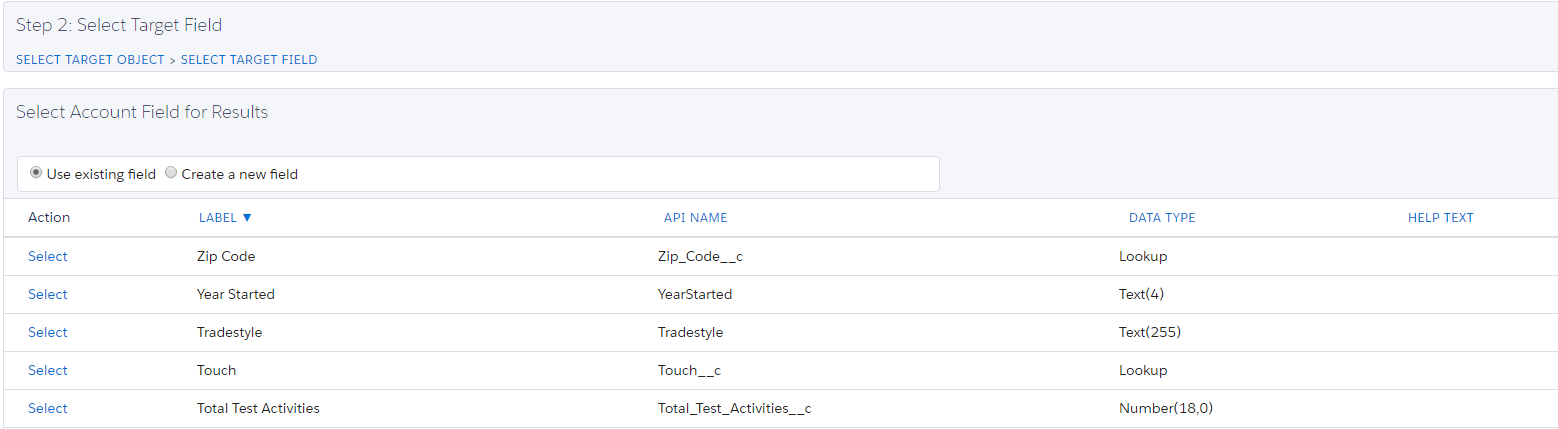
Step two: Select Target Field
This is the field you are rolling up to on the parent object. You tin either:
- Create a new field on the object before inbound the Rollup Helper interface and select information technology from the list.
- Use an existing field of the correct data type by selecting it from the list.
- If you use a field that already exists, Rollup Helper will overwrite whatever data that resides in the field unless you uncheck the Overwrite Existing Target Field Information flag in Advanced Settings (located in Step 3: Select Source Field).
- Select Create a new field to create your results field from within the app.
- For Professional person Edition Salesforce orgs and lower, Salesforce has restrictions in place that block the use of API for field creation. If you are in a Professional Edition Salesforce org or lower, delight create the field on the object as instructed above and so select the field to create your rollup.
- Field security and folio layouts tin be changed from Salesforce Setup.
Changing Field Names
The field label used past Rollup Helper tin be changed at any time. Please annotation, changing the API Name of the results field will crusade the rollup to stop working unless you alter information technology in the rollup equally well.
Step 3: Select Source Field
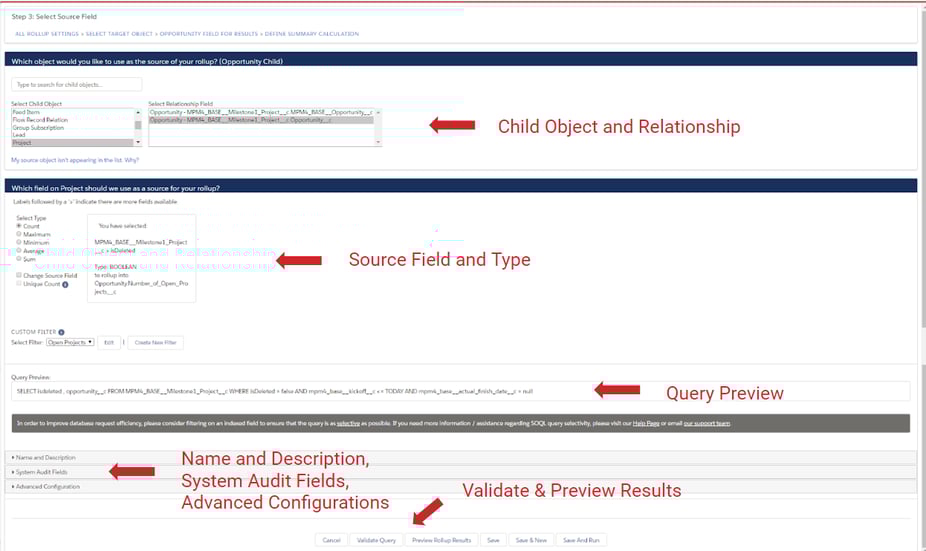
Which object would you similar to use as the source of your rollup? This is the kid object that you are getting the information from.
- Select Kid Object: In the before example of counting the number of Contacts on Account, Contact is the child and would exist the selection here.
- Select Relationship Field: All bachelor relationships between the parent and kid volition appear here.
Which field on 'Child Object' should we use as a source for your rollup?
- Select Type
- The options here are based on the information blazon of the target field. If you are rolling upwards to a number field, for example, you would have options for Count, Max, Min, Boilerplate, and Sum but not Text or Checkbox.
- All fields on the child object of the same or a uniform data blazon every bit the target field will appear in the list. For example, if you selected a Text field as the target in Step 2, fields that house information than can be aggregated in a Text field will appear. If the source field you lot want to use isn't in the listing, delight check the data blazon of the source and target.
- Tip for Count rollups: The 'Deleted' field will be automatically selected for Count rollups by default. Option of the 'Deleted' field (or whatever other field that is guaranteed to be populated on every record) ensures that all records are included in the count. A filter can be added later to narrow down the results that are returned in the rollup.
- Tip for Unique Count rollups: You lot will accept to select "Count" rollup first, then you will have the pick to bank check "Unique Count." If checked, Rollup Helper volition only include unique source records by source field during rollup calculations. The source field must be set up to a source field other than isDeleted in order to enable Unique Count.
- The Query Preview displays the query that will exist run for the rollup.
Proper name and Clarification
- Label: Enter a meaningful name for your rollup.
- Description: Describe what the rollup is doing as well as how and where it is being used.
Audits
When you Edit a Rollup, you will be able to modify any of the fields and filters that you had admission to when creating the Rollup. In that location volition also be a new "Organisation Audit Fields" section at the bottom, which will show information on creation and modification dates. Y'all tin can also see an audit of activation status changes here. The "View Audit Record" button will direct you to a matching PS_Rollup_Audit__c tape. When changes are made to a rollup, the associated Rollup Audit tape will get updated every bit well. Standard field history tracking may exist set upward on the Rollup Audit object to track changes fabricated to rollups.
Advanced Settings
- Use a Custom Sort Field for Max/Min Rollup
- This option is merely available when the rollup aggregation blazon selected is "Maximum" or "Minimum".
- If unchecked, Rollup Helper will sort past the source field in the appropriate direction by default.
- If checked, Rollup Helper will allow you lot to specify an contained field to sort past. For example, if you wanted to roll upward the field of study of the most contempo job, you could select "Discipline" every bit the source field for a Maximum rollup, select "Use a Custom Sort Field for Max/Min Rollup" in the avant-garde configuration, and cull the desired date field to sort past.
- Overwrite Existing Target Field Data
- Selected by default and will update the target field on all records.
- If unchecked, Rollup Helper will not overwrite any field that contains data.
- Employ this if you have information that you do not want to be overwritten, but go along in mind that Rollup Helper volition and so only update records that have a bare value in that field.
- If you accept data on some records that yous don't want to be overwritten, consider creating a new field for Rollup Helper to update.
- Rollup Helper will all the same append new values to the target field, unless the "Suspend To Existing Target Field Information" setting is unchecked every bit well.
- Suspend To Existing Target Field Information
- Selected by default if Overwrite Existing Target Field Information is checked.
- If unchecked, Rollup Helper volition not append any new values to a target field.
- To uncheck, "Overwrite Existing Target Field Data" will need to exist unchecked first.
- Bare Overwrite Existing Target Field Information
- If unchecked, Rollup Helper will not overwrite any field that contains a non-blank value, with a blank value.
- Disable Multiselect Picklist Split up
- Unchecked by default and will count each choice in a mutipicklist as a divide child value.
- If checked, Rollup Helper will not count each option every bit a split kid value.
- Trim Trailing Delimiters
- If checked, Rollup Helper will trim any delimiters that would be placed at the finish of the rolled-upward text value.
- Unique Values Simply
- Check to ensure that Rollup Helper does not add whatever string value to the rolled upwardly text more than once.
- Select Opportunity date field used for dated currency conversion.
- Setting that appears for orgs with advanced currency direction enabled.
- Allows the selection of another date field to be used as the dated currency conversion field.
- Nulls Count Toward Average Calculation
- Unchecked by default for AVG rollups.
- If checked, nil values in source fields will count every bit 0.
- Escape Filter Cord Special Reserved Characters
- Selected by default.
- Utilise this option unless you have a specific reason to forestall Rollup Helper from escaping SOQL reserved characters (i.due east., ' or \).
- Enumerate Text Rollup Results
- Unchecked by default for TXT rollups.
- If checked, child tape values will be numbered in the form "1)... 2)... iii)...." in the rolled-up text value.
- Gyre Upwardly Zero Outcome As Nada
- Unchecked past default for SUM and AVG rollups.
- If checked, when no matching child records are establish for SUM or AVG rollups, Rollup Helper will ringlet up the results equally null instead of 0.
- Query Archived Records
- Unchecked by default.
- Selecting this choice volition rollup from archived and active Salesforce records.
- Disable Realtime
- If checked, will not roll up when run in realtime.
Running The Rollup
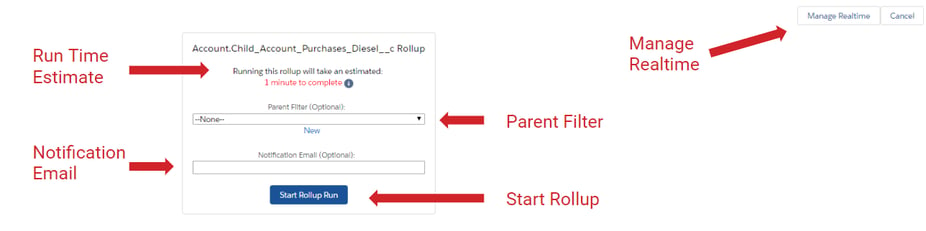
When running, either by clicking Save and Run from the rollup creation page or from clicking Run from the All Rollups Tab, there is a two-stride run process.
- Time Estimation gives an approximate run time based on the number of records to be candy. This fourth dimension tin can vary based on other processes running in the org.
- Optionally, select a parent filter for the rollup run. The parent filter chosen will narrow down the list of records that are updated past the manual run, resulting in a shorter run time if the rollup does not demand to be updated for all records.
- Click 'Run In one case For All Records.'
- Click 'OK' on the pop-up to allow the target field to be overwritten.
- If you don't see the popular-upwards after clicking 'Run Once For All Records,' a popular-up blocker may be preventing it.
Applying Filters to Rollups
During Step 3: Select Source Field, you can choose an existing filter or create a new filter. Filters can be created from scratch or every bit a clone of an existing one (if another filter with the same object type exists in the org). If cloning from an existing filter, the criteria on the existing filter will be carried over to the new i and can be farther edited.
A rollup can exist associated with both a child filter that defines which child records should be rolled upwardly to the parent, and a parent filter that defines which parent records should be processed past the rollup.
Both child and parent filters can be applied to multiple rollups simultaneously and can be used interchangeably - a child filter can be used as a parent filter, and vice versa. Please note that whatsoever tape limits or custom sorts set up on a child filter will exist ignored when used every bit a parent filter, every bit parent filters do not back up record limits and custom sorts.
- Kid Filters
- Child filters are used to ascertain which child records should be rolled up to the parent. During "Step 3: Select Source Field" of creating or editing a rollup, you lot can choose to apply an existing child filter or create a new filter later selecting a source field. Child filters tin be created from scratch or as a clone of an existing i (if some other filter with the same object type exists in the org). If cloning from an existing filter, the criteria on the existing filter will be carried over to the new 1 and tin can be farther edited.
- Please note that referencing the target object through a cross-object child filter will not exclude those target records from being rolled upwards to. In order to ensure those target records are not updated, consider using a parent filter to exclude those target records.
- Parent Filters
- Parent filters are used to define which parent records should be candy by the rollup. When manually running a rollup or creating a schedule for a rollup, you can choose to create a new parent filter or utilise an existing ane (if some other filter with the same object type exists in the org).
Creating a New Filter
Enter Filter Name - Filters tin can be reused for other rollups on the same object, so brand certain to give your filter a meaningful name that you volition be able to recognize in a list.
Limit this rollup to __ child records per parent - Leave this blank for rollups that are simply going to provide ane result because they are aggregating data (sum, average). Otherwise, enter the desired number of results you would like to see. For case, if you are creating a rollup with the name of the nearly contempo iii Opportunities, enter 3.
- This field will auto-populate with a 1 for Min or Max rollups.
Offset
- Skips __ child records per parent (Child Filter Simply): Enter the number of child records to skip for each parent to rollup the nth most recent result. For example, if yous are creating a rollup with the name of the three most contempo Opportunities, enter 1 to rollup the second nearly recent Opportunity.
Specify Sort Gild
- This step can be skipped if the results returned do non demand to be sorted. For case, rollups that are aggregating data such as sum, count, or boilerplate do not require sorting.
- For rollups where yous are limiting the number of records returned, or whatever rollups where yous desire the results sorted such as a listing of text or dates:
- Select the field you would like Rollup Helper to use to sort your records by.
- Select Sort Lodge
- Descending will return the newest or largest results or from Z to A alphabetical sort.
- Ascending volition render the oldest or smallest results or from A to Z alphabetical sort.
Specify Filter Criteria
-
- Select any field that you would like Rollup Helper to filter records on.
- Add an operator.
- When using last_N filters
- If you select = and enter a number, Rollup Helper will return results from the last year, calendar month, etc. and the ones before that depending on the number. For example, if the electric current twelvemonth is 2017 and you utilize the last two years, your results would include 2016 and 2015. Information technology volition exclude 2017.
- If you select < and enter a number it will return results from before that date. For example, if the current twelvemonth is 2017 and you utilise the concluding number of years < 2, your results volition exist from 2014 and all previous years. It is important to notation that when using < that all years, months, etc. from before that grouping will be included.
- If you select <= in the same instance as above, the results would be from 2016, 2015 and 2014 and all previous years.
- SalesforceRelative Date Filter Referencedocumentation.
- Select Criteria
- When inbound Criteria via a text box
- By default, commas can be used to separate multiple values. This transforms the equals and not equals operators into "IN" and "NOT IN", allowing the filter to match against a list of possible values.
- Unchecking the "Separate Criteria Into Multiple Values" checkbox will allow inbound commas without separating the Criteria into multiple values.
- When creating criteria on a polymorphic relationship field:
- Click "Create Sub-Filter" to open up the sub-filter modal. This sub-filter will allow you to create multiple filter criteria on a polymorphic field in the context of a specific object type.
- A maximum of ii sub-filters are allowed per filter.
-
- Submit.
- Repeat these steps to add additional criteria to your rollup.
- Click Save.
- Once you save the filter, information technology will be available to use on additional rollups.

Post a Comment for "Apex Trigger Dlrs_ Has Not Been Deployed. Click Manage Child Trigger and Try Again."